
Masters Group
Specialist Raft Foundation
Design & Construction
in Brighton & East Sussex
When standard foundations won't work, a raft foundation distributes your building's load across its entire footprint — eliminating differential settlement risk and providing a stable platform on even the most challenging ground conditions.
30+ years experience · Complex ground expertise · Fully insured · LABC approved
30+ Years
Foundation expertise
Structural Engineers
In-house design team
LABC Approved
Building control partnership
Fixed-Price Quotes
No hidden costs
What Is a Raft Foundation and When Do You Need One?
A raft foundation is a reinforced concrete slab that covers the entire footprint of a building, distributing structural loads evenly across the ground surface. Unlike strip or trench foundations that concentrate loads along wall lines, raft foundations spread the weight across a much larger area, reducing ground pressure and minimising settlement.
Raft foundations are specified when ground bearing capacity is low, when soil conditions vary across the building footprint, or when differential settlement could cause structural damage. They are common on sites with clay soils prone to shrinkage, areas of made ground, or locations with high water tables.
In Brighton and East Sussex, raft foundations are frequently used for new builds on brownfield sites, extensions on properties with known ground problems, and developments in areas where trees have been recently removed (causing clay heave).
Masters Group works with structural engineers to design raft foundations tailored to your specific site conditions. We manage ground investigation, design, construction, and building control approval as a single coordinated process.
What Happens When Raft Foundations Are Poorly Designed?
An incorrectly designed raft foundation defeats its entire purpose. If the slab is too thin, lacks sufficient reinforcement, or is not properly connected to the superstructure, it cannot distribute loads effectively. The result is the same differential settlement the raft was supposed to prevent.
Poor ground preparation beneath raft foundations causes long-term problems. If fill material is not properly compacted, or if drainage is inadequate, water accumulation beneath the slab can cause heave or washout. Both compromise the foundation's performance and the building above.
Concrete specification errors — particularly using the wrong grade or failing to specify sulphate resistance where needed — accelerate deterioration. In Brighton's clay soils, sulphate attack is a real concern that must be addressed in the concrete specification.
Remediation of a failed raft foundation is extraordinarily disruptive and expensive. The entire building above must typically be temporarily supported while the foundation is reinforced or replaced. Costs can exceed £50,000 for even modest structures.
Our Process
How We Deliver Every Project
Ground Investigation
Detailed site investigation including trial pits, soil sampling, and assessment of bearing capacity, water table, and soil chemistry.
Structural Design
Structural engineers design the raft specification — thickness, reinforcement layout, edge beam details, and concrete grade — based on site data and building loads.
Site Preparation
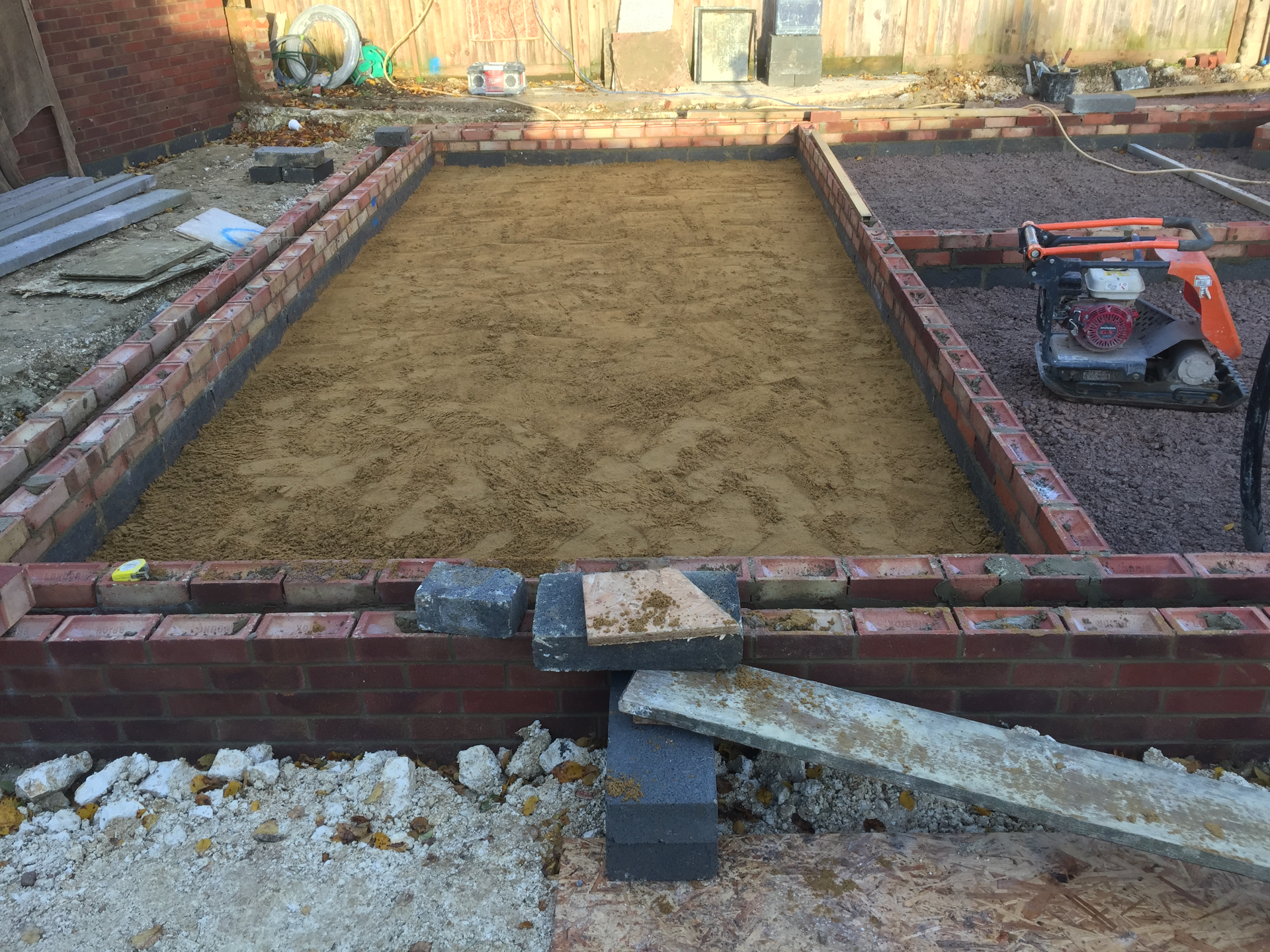
Excavation to formation level, removal of unsuitable material, and installation of compacted sub-base and blinding layer.
Reinforcement & Services
Steel reinforcement placed to design specification. Below-slab drainage, radon membrane, and service ducts installed before concrete pour.
Concrete Pour
Continuous pour of specified concrete mix to achieve monolithic slab. Vibration, levelling, and power-floating to required finish.
Inspection & Handover
Building control inspection at each stage. Curing period before loading. Full documentation and certificates provided.
Why This Matters for Your Project
Eliminates Settlement Risk
Load distribution across the entire footprint prevents the differential settlement that damages buildings on poor ground.
Works on Difficult Sites
Engineered for clay, made ground, variable fill, and high water table conditions where standard foundations would fail.
Integrated Insulation
Raft foundations can incorporate insulation below and within the slab, improving energy performance and meeting current Building Regulations.
Speed of Construction
Once ground preparation is complete, a raft foundation can be poured in a single day — significantly faster than strip or pile-and-beam alternatives.
Cost-Effective on Poor Ground
Where ground conditions would require deep strip foundations or piling, a raft foundation often provides a more economical solution.
Building Control Confidence
Fully engineered design with calculations means straightforward building control approval through our LABC partnership.
Raft Foundations: Specifications, Construction & Technical Detail
A standard domestic raft foundation consists of a reinforced concrete slab typically 200–300mm thick, with thickened edge beams around the perimeter and beneath internal load-bearing walls. The edge beam is usually 450–600mm deep and 400–500mm wide, providing additional rigidity and resistance to edge loading.
Reinforcement typically consists of two layers of steel mesh (A393 or A252) with additional bars in edge beams and beneath point loads. The reinforcement design is specific to each project and is calculated by the structural engineer based on building loads and ground conditions.
Below the concrete slab, the build-up typically includes: 150mm compacted Type 1 sub-base, 50mm sand blinding, damp proof membrane (DPM), and rigid insulation board (typically 100–150mm of PIR or EPS). The insulation position — above or below the slab — depends on the structural design and thermal requirements.
Concrete specification for raft foundations in Brighton typically calls for C30 or C35 concrete with a maximum water-cement ratio of 0.50. Where sulphate exposure is classified as DS-2 or higher (common in Brighton's clay soils), sulphate-resisting Portland cement or ground granulated blast-furnace slag (GGBS) is specified.
Services below the raft — drainage, water supply, electrical ducts — must be installed before the concrete pour. Any services that pass through the raft require sleeves or proprietary penetration seals to maintain the integrity of the DPM and structural slab.
Raft foundation costs in Brighton typically range from £120–£200 per square metre, depending on thickness, reinforcement density, and ground preparation requirements. For a typical 80m² extension or new build footprint, expect £10,000–£16,000 for the complete raft foundation.
Frequently Asked Questions
Need a Raft Foundation for Your Project?
Get a free, no-obligation estimate. Engineered design, site-specific solutions, and fixed-price delivery from ground investigation to building control sign-off.